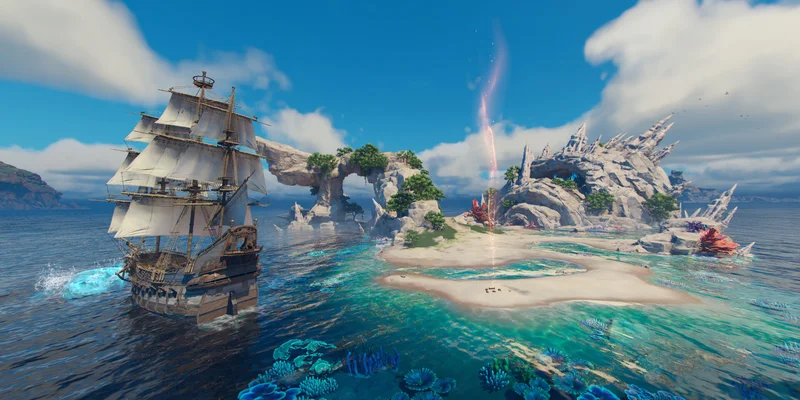
- Sea of Remnants gameplay centers on ocean exploration, crew combat, fleet building, and story progression.
- Start with the main objectives to unlock exploration, combat, crew, and fleet systems efficiently.
- Build a focused core crew before spreading development materials across the full roster.
- Match ships and crew to the activity, whether progressing the story, gathering resources, or facing difficult battles.
- Treat CBT information separately from final launch details because test content may change.
Sea of Remnants Gameplay Overview
Sea of Remnants gameplay combines a maritime open world with turn-based combat, recruitable crew members, fleet management, and the development of Orbtopia. The player takes the role of a memory-lost puppetfolk sailor and begins a voyage shaped by exploration, encounters, recruitment, and unanswered questions about the world.
The most effective progression loop is straightforward: leave port, identify an objective, explore nearby locations, resolve encounters, collect useful materials, and return to improve the crew or fleet. Main-story objectives should remain the backbone of progression because they help unlock additional systems and broader activities.
The game is still in a pre-release testing phase. The Dawnbreaker CBT is scheduled as a limited test during 2026, so available characters, systems, balance, and progression details should be treated as test-build information rather than final release guarantees.
Explore
Sail through changing waters, discover locations, investigate events, and collect resources during each route.
Recruit
Build a flexible crew around damage, defense, support, and exploration utility.
Battle
Use turn-based decisions, role coverage, positioning, and skill timing to handle encounters.
Develop
Improve ships, crew, fleet structure, and Orbtopia as new progression options become available.
| Gameplay System | Main Purpose | Beginner Priority |
|---|---|---|
| Ocean exploration | Reach locations, uncover events, and gather materials | High |
| Turn-based combat | Resolve encounters through crew roles and tactical decisions | High |
| Crew development | Improve the characters used in regular progression | High |
| Fleet building | Combine ships and crew for different objectives | Medium |
| Orbtopia | Support city, NPC, trading, and progression activities | Medium |
Use the main story to unlock systems first. Optional exploration becomes more efficient after your crew and fleet can handle routine encounters.
Step-by-Step Gameplay Progression
A stable opening route prevents wasted materials and gives new players a clear order for learning Sea of Remnants systems. The goal is not to upgrade every available option immediately. Instead, establish one dependable progression team, learn the exploration loop, and expand only when the next system or objective requires it.
Complete the Opening Objectives
Follow the early objectives until the basic exploration, combat, crew, and fleet systems are available. Avoid spending heavily on optional upgrades before you understand which systems support the main progression route.
Learn the Exploration Loop
Check the world map before sailing, identify the next objective, and collect nearby resources when they fit naturally into the route. Keep enough supplies and combat strength to complete the return journey.
Create a Core Crew
Select a small group that covers offensive pressure, durability, and utility. Upgrade the members used most often instead of distributing early materials evenly across the entire roster.
Improve the Main Fleet
Prioritize ship improvements that support survivability, damage, access to objectives, or reliable travel. Keep a material reserve for story requirements and future crew development.
Return to Optional Content
After reaching a story checkpoint, revisit side encounters, resource routes, and exploration locations. Use optional content to fill specific resource gaps rather than replacing the main progression path.
| Progression Stage | Primary Action | What to Avoid |
|---|---|---|
| Opening | Unlock core systems | Overspending on unknown upgrades |
| Early exploration | Follow nearby objectives | Long detours for low-value rewards |
| Crew setup | Build a balanced team | Leveling the entire roster at once |
| Fleet setup | Improve the main vessel | Equal investment in every ship |
| Expansion | Add specialists for new activities | Ignoring the main story |
Dawnbreaker CBT features and progression may not represent the final version. Record strategies by test build and avoid treating temporary balance as permanent design.
Combat, Crew, and Fleet Strategy
Combat success depends on how well the crew and fleet work together. A damage-focused character may perform strongly when protected, while a defensive or support member can create more value by extending the team’s time in battle. Formation decisions should therefore reflect the encounter rather than a single universal ranking.
The currently announced CBT roster contains 21 playable characters, but the available materials do not establish a complete named-character ranking or final numerical balance. A role-based framework is more reliable for early planning than inventing fixed statistics.
| Role | Primary Function | Best Use | Investment Priority |
|---|---|---|---|
| Damage | Applies consistent offensive pressure | Main story and difficult encounters | High |
| Defense | Absorbs pressure and protects allies | Bosses and extended battles | High |
| Support | Improves survival, control, or team output | Formation-based encounters | High after core damage |
| Exploration utility | Supports travel, gathering, or route efficiency | Resource runs and discovery | Medium |
| Specialist | Excels under specific conditions | Restricted or challenge encounters | After core team |
When building a fleet, define the objective before selecting upgrades. A story fleet should remain balanced, a resource fleet should support efficient travel and gathering, and a high-difficulty fleet should focus on survival and concentrated damage.
Story Formation
Use a durable frontline, dependable damage, and utility that remains useful across regular encounters.
Resource Formation
Favor travel efficiency, carrying capacity, gathering support, and enough combat power for unexpected encounters.
Difficult Battle Formation
Combine frontline protection with control, recovery, defensive tools, and focused attacks against priority targets.
| Activity | Fleet Goal | Recommended Focus |
|---|---|---|
| Main story | Balanced progression | Survivability, repeatable damage, flexible utility |
| Resource gathering | Longer operating time | Travel efficiency, cargo, gathering support |
| High-difficulty combat | Survive concentrated pressure | Defense, control, recovery, focused damage |
Do not judge a crew member only by direct damage. Protection, recovery, control, and exploration utility can determine whether a formation remains efficient over a full route.
Exploration, Orbtopia, and Resource Planning
Exploration is more than travel between combat encounters. The ocean world supports discovery, locations, events, resources, and contact with different communities. Route planning matters because a profitable expedition should balance progress, supplies, combat readiness, and the value of the discoveries along the way.
Orbtopia serves as a key city setting where players can interact with NPCs, access facilities, manage services, and support broader progression. The development team has described the world as containing more than 400 named NPCs, each associated with individual story arcs that can be influenced by player actions. This makes city interaction an important part of the game’s narrative identity, not just a menu between voyages.
| Location or System | Gameplay Value | Planning Question |
|---|---|---|
| Open ocean | Connects regions and activities | Is the route worth the travel cost? |
| Islands and points of interest | Offer discoveries, events, and materials | Can the crew handle the expected encounter? |
| Orbtopia | Provides city functions and NPC interactions | Which facility or character supports the current goal? |
| Exploration events | Add risk, rewards, or story context | Does the reward justify changing course? |
| Resource routes | Supply crew and fleet development | Can the route be repeated efficiently? |
Use this planning checklist before leaving port:
Voyage Preparation Checklist:
- Confirm the next story or exploration objective
- Review crew roles and place durable members in exposed positions
- Reserve materials for required crew and ship upgrades
- Carry enough supplies for the planned route and return
- Check whether Orbtopia has a useful facility or NPC interaction
The best early resource policy is selective investment. Upgrade the systems that directly improve your current objective, then keep a reserve for newly unlocked requirements. This approach is safer than spending everything on a broad collection of low-priority improvements.
Combine nearby discoveries with the main objective whenever possible. Efficient routes reduce unnecessary travel and leave more resources for crew and fleet development.
Dawnbreaker CBT and Current Access Status
The Dawnbreaker CBT is a closed testing phase for Sea of Remnants, not the final public release. It is designed to evaluate a selected game build and gather player feedback before wider availability. The announced test includes 21 playable characters and highlights the game’s exploration, combat, crew, and progression systems.
Players should use the official Sea of Remnants website, the Steam store page, and the official Discord community for registration instructions, access announcements, platform requirements, and test updates.
| Status | What It Means | Where to Check |
|---|---|---|
| Dawnbreaker CBT | Limited pre-release test with selected content | Official announcements and Discord |
| Steam listing | Store page for product information and updates | Steam |
| Formal release | Separate from CBT access and test dates | Official website and Steam |
| Public testing | Availability depends on future announcements | Official channels |
The game is not yet a completed live-service release at the time of this article. Test access can depend on eligibility, region, platform, account requirements, and the active announcement window. Do not assume that joining a test guarantees access to every feature or that test progress will transfer to a later build.
Check the active announcement before attempting to join. CBT participation, public testing, and formal launch are separate stages with different requirements.
Sea of Remnants Gameplay FAQ
Q: What is the main focus of Sea of Remnants gameplay?
The main loop combines ocean exploration, turn-based combat, crew recruitment and development, fleet building, resource planning, story progression, and activity in Orbtopia.
Q: What should beginners upgrade first?
Begin with the crew and ship systems used for main-story progression. Build a balanced core team, improve essential survivability and damage, and keep materials available for newly unlocked requirements.
Q: How should I build a fleet for different activities?
Use a balanced fleet for story progression, travel and gathering support for resource routes, and stronger frontline protection with focused damage for difficult combat.
Q: Is the Dawnbreaker CBT the final version of the game?
No. Dawnbreaker is a closed test with selected content. Character balance, progression, available systems, and other gameplay details may change before the formal release.
Tier lists, character evaluations, and system details should be labeled with the relevant test build or version. Future updates may change the recommended crew, fleet priorities, and progression route.
Related Sea of Remnants Guides
Continue with these Sea of Remnants guides: