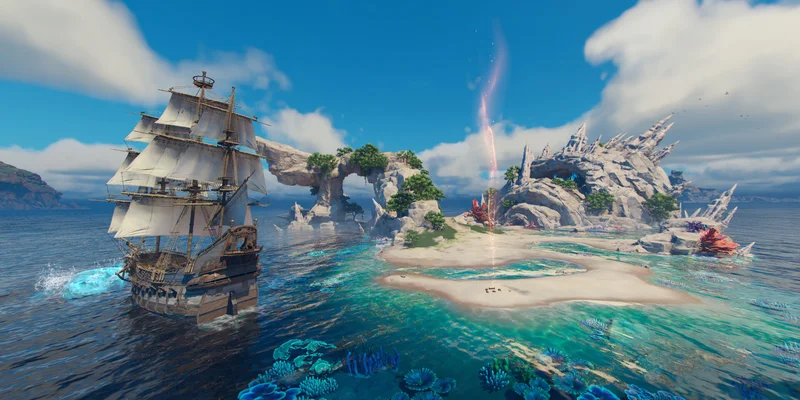
- Sea of Remnants combat combines turn-based island battles with real-time-style naval encounters.
- Assign a crew before sailing because selected members accompany you during exploration and fights.
- Build characters around class identity, professional skills, equipment, and upgraded talents.
- Upgrade ships by parts to improve their effects, skills, and performance against sea threats.
- Treat CBT details as provisional because test-period balance and systems may change before launch.
Sea of Remnants Combat Basics
Sea of Remnants combat is built around two connected battle environments. On land, the game uses a turn-based open-world RPG structure with character abilities, classes, equipment, and crew development. At sea, players control a selected vessel while facing sea monsters and rival pirate ships with cannons.
The most important decision comes before the first attack: prepare both your crew and your ship. A strong land party does not automatically solve every naval encounter, and a well-upgraded vessel cannot replace a poorly planned character lineup on an island. Treat every expedition as a combined loadout.
Video Highlights:
- Turn-based character battles on islands
- Naval encounters against sea monsters and pirate ships
- Ship selection, customization, and crew assignment
- Character classes, professional skills, and advanced classes
- World-boss combat shown during the test version
| Combat layer | Main focus | Preparation priority | Typical threat |
|---|---|---|---|
| Land battle | Turn-based character actions | Skills, equipment, class setup | Island enemies and bosses |
| Sea encounter | Ship movement and cannon attacks | Vessel parts, ship effects, assigned crew | Sea monsters and pirate ships |
| Character growth | Stats, talents, and abilities | Crew training and mind enhancement | Difficult encounters |
| Expedition planning | Switching between land and sea | Balanced crew and ship selection | Long journeys between islands |
The combat loop rewards deliberate preparation rather than rushing into every encounter. Begin from your settlement and docks, choose a ship, assign crew members, then sail across the world map. When you reach an island, the same crew becomes the foundation for land exploration and turn-based battles.
Build the expedition as one package: ship choice, crew assignment, character skills, and equipment should support the same objective.
Naval Combat and Ship Setup
Naval combat gives Sea of Remnants a second tactical layer. During ocean travel, you may encounter sea monsters or other ships. Cannons are the central offensive tool shown in the available test footage, so ship preparation matters before leaving the docks.
Ships can be customized and upgraded piece by piece. Individual parts may provide additional effects or skills, which means ship progression is not limited to a single generic power level. When preparing for a voyage, compare the vessel’s available customization options with the type of encounter you expect to face.
| Naval preparation | What to check | Why it matters |
|---|---|---|
| Ship selection | Available vessel and customization options | Determines your starting combat configuration |
| Part upgrades | Individual ship pieces | Adds effects or skills to the vessel |
| Crew assignment | Members selected before departure | Defines who joins the expedition |
| Cannon readiness | Offensive capability for sea fights | Supports attacks against ships and monsters |
| Route planning | Islands and ocean encounters | Helps control when to fight or explore |
A practical naval setup follows three stages:
Choose the Vessel
Start at the docks and select the ship that best matches your current upgrade path. Do not treat the vessel as a cosmetic choice; its parts and available effects shape how you approach ocean encounters.
Customize Key Parts
Review the ship piece by piece and install available upgrades that improve its effects or skills. Prioritize changes that strengthen the way you already intend to fight rather than spreading resources across unrelated options.
Assign the Crew
Select the crew members who will travel with you before sailing. The assigned group accompanies the expedition, so confirm the lineup before leaving the port.
Sail and Reassess
Enter the world map, watch for islands and hostile encounters, and reassess your setup after each major battle. Use the results to decide whether the next upgrade belongs on the ship or on the crew.
The safest approach is to avoid viewing every sea encounter as a mandatory fight. Ocean travel includes exploration, island landings, sea monsters, and rival ships. If your vessel or crew is not ready, use the route to gather experience with the system and return to upgrade before taking on a more demanding target.
Naval balance, ship effects, and encounter difficulty are based on available test-period information and may change before the final release.
Character Classes, Skills, and Crew Growth
Land battles depend on how each crew member is developed. The available combat overview identifies a standard ability structure with passive skills, normal skills, and ultimate skills. These abilities can be upgraded alongside character stats, creating a clear progression path for both basic actions and high-impact turns.
Class identity adds another layer. Characters belong to classes such as Ravager and Cutthroat in the test footage, while advanced options include names such as Juggernaut and Swashbuckler. The footage indicates that an advanced class becomes available at level five, but exact class counts, numerical values, and final balance should not be assumed from the test version.
| Character system | Function | Recommended use |
|---|---|---|
| Passive skill | Provides a persistent effect | Match it to the character’s intended role |
| Normal skill | Supplies repeatable combat utility | Use it to manage routine turns |
| Ultimate skill | Delivers a major combat effect | Save it for bosses or decisive moments |
| Professional skill | Swappable, class-based option | Adjust the character to the expedition |
| Advanced class | Unlocks later class direction | Choose after understanding the base role |
| Equipment | Improves the combat setup | Keep gear aligned with the character’s role |
Professional skills are especially important because they can be swapped and are connected to class identity. Instead of treating a character as permanently locked into one ability pattern, review the available professional options when the expedition’s needs change.
Crew development also includes two separate training paths. The available information describes limb upgrades as a way to improve stats, while mind enhancement improves skills and talents. Use this distinction when deciding where to place resources.
Core Skills
Passive, normal, and ultimate skills form the basic combat kit. Upgrade them according to encounter demands.
Class Identity
Base and advanced classes shape the character’s direction. Review the role before selecting talents.
Professional Skills
Swappable, class-based options provide flexibility when the crew or target changes.
Crew Training
Limb upgrades support stats, while mind enhancement develops skills and talents.
Professional skills can be adjusted to suit different encounters, so review them before difficult island battles instead of relying on one fixed setup.
Step-by-Step Battle Routine
The most reliable combat routine is built around information. Before committing to a difficult encounter, identify whether the threat is on land or at sea, confirm the crew assigned to the expedition, and check whether the relevant upgrades support that situation.
Identify the Battlefield
Decide whether the next challenge is a turn-based island fight or a naval encounter. This determines whether character preparation or ship preparation should receive priority.
Check the Expedition Package
Confirm the selected ship, installed ship parts, assigned crew, equipment, and available professional skills. This short check prevents mismatched preparation.
Open with Efficient Actions
In land combat, use normal skills for routine pressure and preserve stronger abilities for moments that justify them. At sea, maintain cannon pressure while watching the encounter’s pace.
Spend Major Abilities Carefully
Passive effects work continuously, but ultimate skills should be reserved for critical turns, bosses, or moments where ending the threat quickly protects the expedition.
Upgrade After the Fight
If the battle exposes a weakness, decide whether the solution is a character improvement, a professional skill change, equipment, or a ship-part upgrade before continuing.
| Situation | First adjustment | Second adjustment | Avoid |
|---|---|---|---|
| Land battle feels inefficient | Review professional skills | Upgrade skills or equipment | Changing every system at once |
| Sea encounter is difficult | Inspect ship parts | Reconsider vessel and crew | Sailing repeatedly without upgrades |
| Boss survives too long | Save ultimate skills for key turns | Improve talents or stats | Spending major abilities without a plan |
| Crew feels underpowered | Use limb upgrades for stats | Use mind enhancement for skills | Ignoring both training paths |
| Expedition lacks flexibility | Reassign crew or skills | Change the ship setup | Treating one build as universal |
A strong routine is not about using every ability immediately. It is about matching the action to the encounter. On land, conserve high-impact skills until the battle’s dangerous phase. At sea, maintain pressure while using ship customization to address recurring weaknesses.
After each difficult encounter, record the specific problem: insufficient damage, weak survivability, poor flexibility, or an unsuitable ship setup. Upgrade the matching system rather than making random changes.
Combat Checklist and Progression Priorities
Use the following checklist before long voyages, island bosses, or any encounter that has already defeated your current setup. It focuses on confirmed systems rather than unannounced numbers or tier rankings.
Combat Preparation Checklist:
- Select a ship and review its available customization options
- Assign the crew members needed for the upcoming expedition
- Check passive, normal, and ultimate skills before entering land combat
- Review professional skills, class direction, and equipment
- Choose between limb upgrades and mind enhancement based on the current weakness
| Upgrade priority | Best time to consider it | Expected benefit |
|---|---|---|
| Ship parts | Repeated naval losses | Better vessel effects or skills |
| Professional skills | Role or encounter changes | More adaptable character setups |
| Equipment | Land damage or survivability issues | Stronger individual performance |
| Limb upgrades | General stat weakness | Improved character attributes |
| Mind enhancement | Skill or talent limitations | Better-developed combat options |
Progression should remain focused. If a character’s stats are acceptable but the ability kit feels limited, mind enhancement may be more relevant than another general stat increase. If the entire expedition struggles against sea monsters, inspect the ship before investing only in individual characters.
The settlement and docks also function as a natural preparation hub. Begin each journey there, select the vessel, assign crew, and make changes before entering the world map. This keeps the transition between exploration and combat deliberate.
Upgrade the system responsible for the problem you are experiencing. Naval losses point toward ship preparation, while weak island turns usually point toward skills, equipment, class choices, or crew training.
Sea of Remnants Combat FAQ
Q: What type of combat does Sea of Remnants use?
It combines turn-based RPG combat on islands with naval encounters involving ships, cannons, sea monsters, and rival pirate ships.
Q: Does the crew affect both land and sea exploration?
The selected crew travels with the expedition after being assigned at the port. They support the island exploration and character-focused combat portion of the journey.
Q: When can characters choose an advanced class?
Available test-period information indicates that an advanced class can be selected at level five. Exact final class details may change before release.
Q: What should I upgrade first after losing a battle?
Identify the source of the loss. Improve ship parts after naval problems, or review skills, equipment, professional skills, and crew training after difficult land battles.
The available combat material comes from a test-period overview titled Sea of Remnants - Combat System & World Boss Gameplay. Because the game remains in pre-release development during 2026, treat specific balance observations as provisional rather than final rankings.
Do not turn test footage into permanent tier lists or fixed numerical advice. Class names, ship effects, progression requirements, and encounter balance may be revised in later builds.
Related Sea of Remnants Guides
Continue with these Sea of Remnants guides: